

21 August 2025
How we could help you avoid “pension recycling”
;)
Pensions are an incredibly tax-efficient way to save for retirement. Your investments can grow free from tax, and the government even “tops up” your contributions with tax relief.
With such generous rules already in place, it might be tempting to push further, to maximise these tax benefits and ensure your retirement savings stretch as far as possible.
However, some strategies that might seem clever on the surface can lead to unintended consequences.
One such pitfall is “pension recycling”, with its complex set of rules introduced by HMRC in 2006 to prevent the abuse of tax relief.
Continue reading to discover how pension recycling rules work and how breaching them could trigger a significant tax charge.
Pension recycling rules and conditions are highly complex
Pensions already offer a number of tax advantages without the need to take unnecessary risks.
Tax relief is one of these advantages. The government essentially “tops up” your pension at your marginal rate of Income Tax, meaning a £100 contribution would effectively “cost”:
- £80 for basic-rate taxpayers
- £60 for higher-rate taxpayers
- £55 for additional-rate taxpayers.
Any investments within your pension also grow free from Income Tax, Capital Gains Tax, and Dividend Tax.
Still, some people might attempt pension recycling to stretch their tax efficiency further.
Simply put, pension recycling occurs when you take tax-free cash from your pension and use it, either directly or indirectly, to boost your pension contributions beyond a certain threshold.
Typically, you must meet certain conditions before HMRC classifies your actions as pension recycling
HMRC will first look at the total amount of tax-free cash you have taken within the last 12 months. This could include payments from other pension schemes.
If the total is £7,500 or less, you wouldn’t have triggered pension recycling rules.
They will then examine whether your pension contributions have risen significantly, typically by more than 30% compared to what might be considered your “usual” contribution.
HMRC may even use inflation data to establish a value for expected contributions over a five-year period, and this includes:
- Personal payments
- Employer contributions
- Third-party contributions.
Then, they compare the total increase in contributions over this period with the lump sum you withdrew. The rules may apply if the extra contributions amount to more than 30% of the lump sum.
Even using other funds to make the contributions, such as taking a loan or dipping into other sources of savings, doesn’t mean you’ll avoid the issue.
Finally, HMRC will consider your intent. If you always planned to take the lump sum and use it to increase contributions, this will be classed as “pre-planning”.
While this might be subjective, it could still result in a breach, even if the increased contributions were made before you took the lump sum.
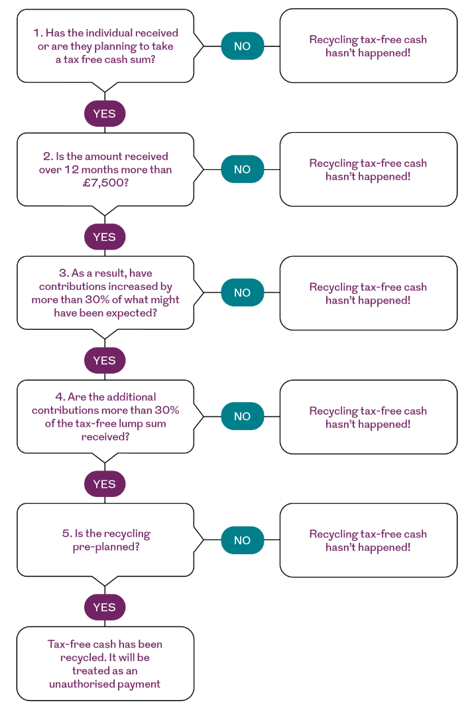
The helpful flowchart below from Royal London shows exactly how the rules might work.
Source: Royal London
As you can see, the conditions surrounding pension recycling are incredibly complex, and you could face unintended consequences by pushing the rules.
The charges for pension recycling are costly and could derail your progress towards your goals
Falling foul of pension recycling rules can quickly become costly. If HMRC decides your actions are classified as recycling, they might treat your lump sum as an “unauthorised payment”.
This means it no longer enjoys its tax-free status, and several charges may apply.
One of these is an unauthorised member payment charge of 40% of the lump sum. On top of this, you could face a 15% surcharge.
There may also be a 40% scheme sanction on the payment itself. Or, in more extreme cases, HMRC could de-register your pension scheme, triggering a 40% charge on the entire fund.
Of course, not all of these penalties will apply in every case, but even one of them could quickly become costly.
This could undermine your hard work and derail your progress toward the retirement lifestyle you’ve been dreaming of.
Optimum Path can help you make the most of already available tax benefits
Given the advantages offered by pensions, it’s usually better to work within the rules rather than attempting to outsmart them. This is where financial planning can help.
Optimum Path could help you structure your pension savings to remain compliant and aligned with your long-term goals.
We can also review your current contributions and assess the tax relief you’re entitled to, ensuring you make the most of the tax benefits available.
Be sure to contact us now to find out how our Chartered financial planners can help.
Please note
This article is for general information only and does not constitute advice. The information is aimed at retail clients only. All information is correct at the time of writing and is subject to change in the future.
A pension is a long-term investment not normally accessible until 55 (57 from April 2028). The fund value may fluctuate and can go down, which would have an impact on the level of pension benefits available. Past performance is not a reliable indicator of future performance. The tax implications of pension withdrawals will be based on your individual circumstances. Thresholds, percentage rates, and tax legislation may change in subsequent Finance Acts.
Your pension income could also be affected by the interest rates at the time you take your benefits. The tax implications of pension withdrawals will be based on your individual circumstances, tax legislation, and regulation, which are subject to change in the future.
The Financial Conduct Authority does not regulate tax planning.
Category: News